Behind every square metre of built-up area is a wage - and it is smaller than most people assume. Today we want to walk through what construction workers in the UAE actually earn, trade by trade, including the parts of the package that never appear on a payslip.
What the trades actually earn
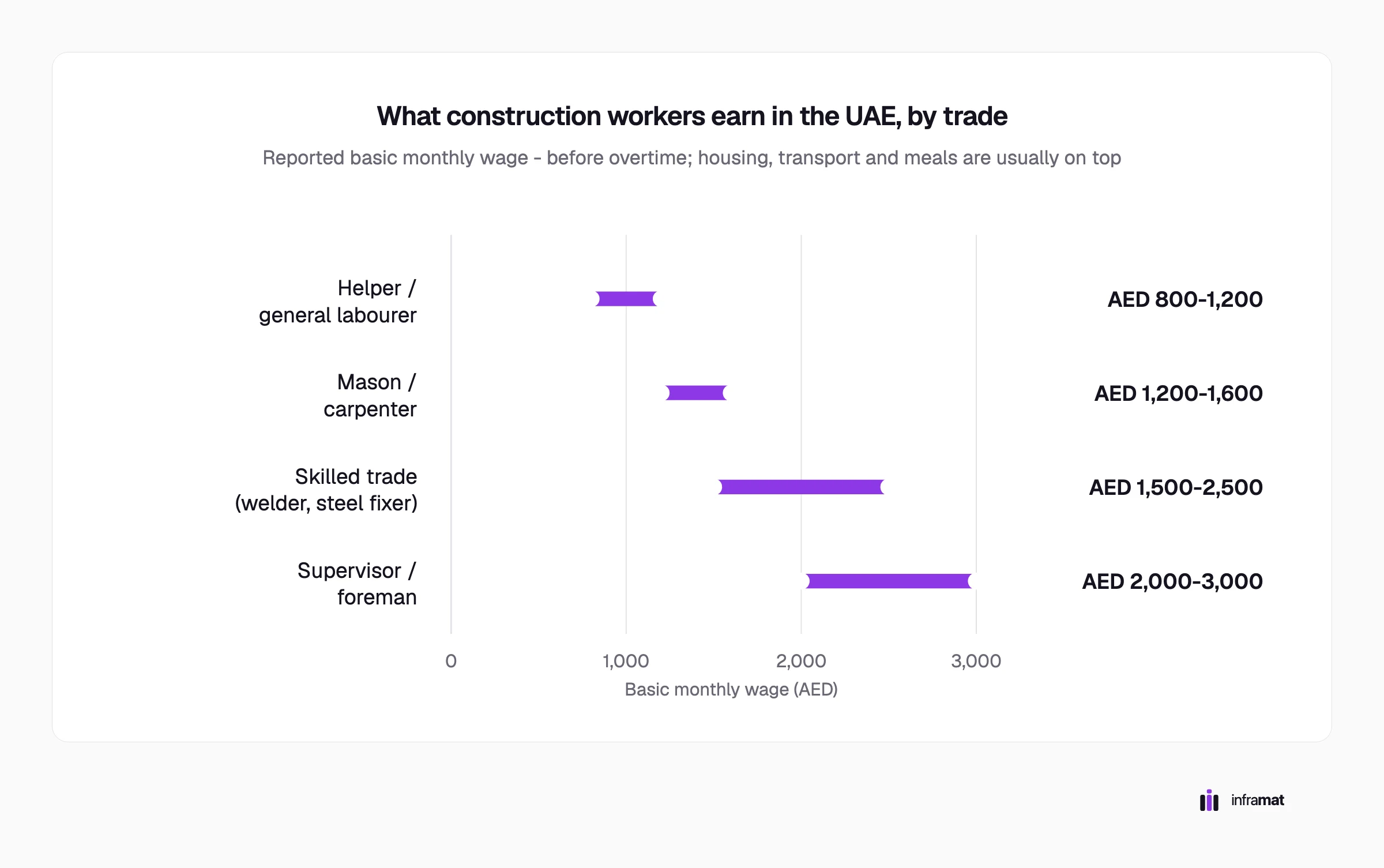
Ask on the ground and a fairly consistent picture emerges. A general labourer or “helper” earns somewhere around AED 800 to 1,200 a month. A mason or carpenter, AED 1,200 to 1,600. The more specialised trades - welders, steel fixers, shuttering carpenters - run AED 1,500 to 2,500, with experience and nationality moving the figure inside that band. And a supervisor or foreman, the one promotion most workers never reach, earns AED 2,000 to 3,000.
The payslip is not the whole package
Two things sit around that basic wage, pulling in opposite directions. On one side, most employers provide accommodation, transport to site and often meals, so the cash figure understates what it costs to keep a worker on the books - a stated salary of AED 1,000 is not AED 1,000 of living cost.
On the other side, some companies deduct roughly AED 200 for food and transport, and a large share of take-home actually comes from overtime. Ten- to twelve-hour days, six days a week, lift monthly earnings to something like AED 1,500 to 2,300 for many workers. Expressed by the hour, the basic rate lands at around AED 3 to 5.
A large share of site labour arrives through manpower-supply agencies rather than direct hire. The agency takes a cut, so an agency-supplied worker typically earns less than the rate the contractor pays for them - one reason two sites next to each other can carry very different wages for the same job.
What it costs the subcontractor
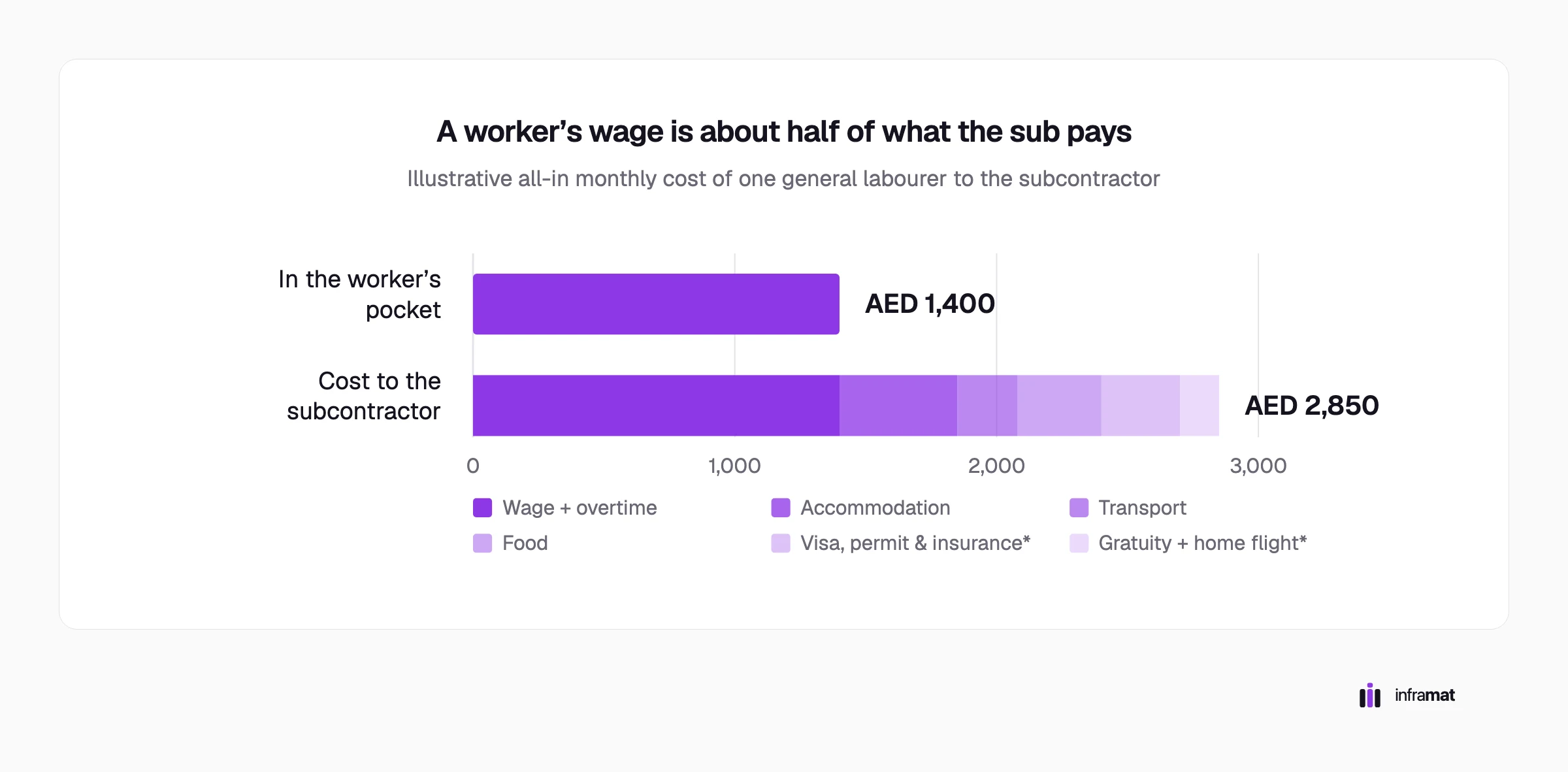
The wage in the worker’s pocket is only the visible part of the bill. The subcontractor who employs him is also paying for the bed in the labour camp, the bus to site, usually the food, and a stack of one-off and statutory costs - the visa and work permit, the medical test and Emirates ID, mandatory health insurance, an end-of-service gratuity that accrues every month, and a home flight every couple of years. Spread those across the month and the true cost of a worker runs to roughly double what he takes home.
The number that rarely enters the conversation
The exact figure moves with the trade and the company, but the shape holds. For a general labourer taking home something like AED 1,200 to 1,600 in cash, the all-in monthly cost to the subcontractor lands closer to AED 2,300 to 3,300 once housing, transport, food and statutory costs are counted. Wage and overtime are a little over half of it; the rest is simply the cost of keeping a person housed, moved, insured and legal in the country.
It cuts both ways. It is why “just pay them more” runs straight into the subcontractor’s own cost base - a raise on the wage sits on top of an already-doubled figure - and it is also why a worker on a modest cash wage is, on the employer’s ledger, a far heavier line than the payslip suggests. A subcontractor pricing a labour line is really budgeting the whole stack, not the wage.
The contractor’s side
It is easy to read these figures as pure exploitation, and much of the public debate does exactly that. The contractors in that debate push back with an economic argument worth hearing on its own terms: margins on the trade are thin - around 15% before overheads, and less once they are counted - clients demand discounts and resist any price increase, and visas and overheads keep climbing. In that frame, the wage is what the market will bear, not what the contractor would choose to pay in the abstract.
And yet the same contractor said he pays above the going rate - around AED 2,500 - to stop good workers being poached, which points to the other half of the truth. Where a skill is scarce and a visa is hard to secure, wages do move.
“No one is forced to work at this salary. That is how much the market can afford to pay.”
“I pay my workers 2.5k so they don’t get snatched.”
Holding both truths
Both things are true at once. The hours are long, the accommodation is cramped - six to twelve to a room is common - and by the standard of a tradesperson in the United States or Europe the pay is very low. At the same time, many workers weigh the job against materially worse options at home and take it deliberately, sending most of the wage back to families for whom it stretches a long way.
Neither the “it is exploitation” nor the “it is a rational choice” framing is complete on its own, and the honest reading holds both. Where observers tend to agree is on the direction of travel: stronger labour protections and greater wage transparency are what would actually lift the floor, and the market’s appetite for the cheapest possible build is part of what holds it down.
For anyone pricing a project in the Emirates, the labour line is the foundation the rest of the estimate rests on. Understanding it honestly - the numbers and the context together - is simply part of doing the work well.
Thanks for your attention. See you next time.